

How to time block with a baby (when naps are unpredictable)
How to plan your day around a baby whose naps change daily: block nap windows, keep a nap menu, sort tasks and re-plan in two minutes.
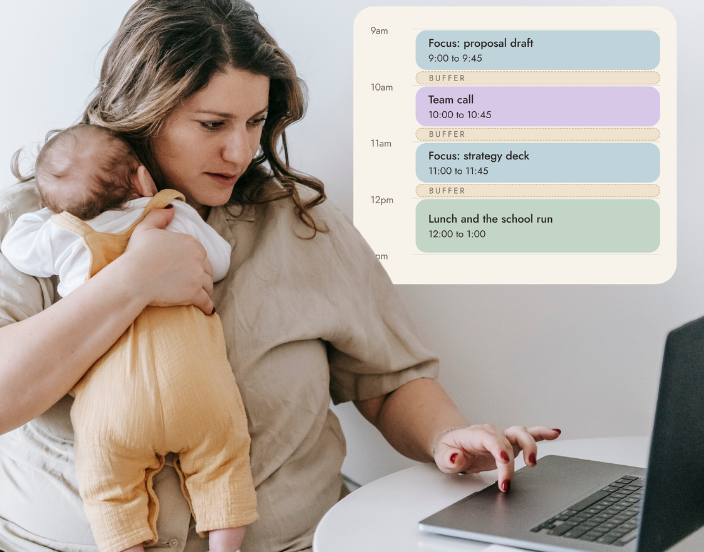
It's a Thursday you're working from home, and the plan was lovely. The baby would nap at one, you'd write the strategy deck from one until half past two, and the morning would take care of itself with a few calls and a playmat. Then at ten forty the eye rubbing starts, by eleven she's asleep on your shoulder, and the deck is sitting in a tab you haven't even opened. If you've tried time blocking with a baby, you'll know the small sinking feeling of watching a perfectly good plan go out of date before lunch.
The afternoon follows the same pattern. The one o'clock nap you built everything around arrives at eleven, lasts thirty-five minutes instead of ninety, and leaves you with a wide-awake baby, a deck that's still blank and a growing suspicion that planning is something other people get to do.
Planning with a baby works perfectly well once the plan is built to move. This guide shows you how to time block around an unpredictable nap schedule, with five practical habits and a sample day, so the important things still get done on the days the naps go their own way.
Why naps make an ordinary plan wobble
Most time blocking advice assumes you decide when each hour starts. A baby's nap schedule decides a good part of that for you, and it changes as she grows. The Canadian Paediatric Society's parent site explains that most babies need three naps a day by about four months, then move to two longer naps somewhere between six and twelve months, and it adds that some babies nap for as little as twenty minutes at a time while others sleep for three hours or more. A systematic review of 34 studies on normal sleep in children found the same wide spread, with healthy infants sleeping anywhere from roughly ten to sixteen hours a day.
In other words, a nap that wanders is normal, and a plan that relies on it arriving at one o'clock sharp was always going to struggle. My guide to time blocking for working moms covers the three blocks every mom needs. This piece zooms in on the hardest part of that picture, which is the stretch of the day when the baby is with you and the naps set the rhythm.
Five ways to time block around unpredictable naps
1. Block nap windows instead of nap times
Plan around the range, then let the exact time land where it lands. Look back over the last week and notice when naps usually happen, then block that window in your calendar. If the morning nap tends to fall somewhere between nine thirty and eleven, block the whole stretch as "nap window" and keep anything with a fixed start time, like a call with your manager, outside it. A window is honest about what you know, and it keeps you from booking a meeting into the exact half hour that turns out to be bath and a cuddle.
2. Give every nap a menu
Decide in advance what you'll do with a short nap and what you'll do with a long one. The cruellest part of an unpredictable nap is the first five minutes, spent standing in the hallway wondering what to do with them. Cal Newport, who time blocks his entire working day, suggests giving open-ended blocks a secondary purpose so any spare time goes straight to something you care about, and a nap menu works the same way. Before the day starts, write down one task for a twenty-minute nap (reply to the daycare forms email, outline the deck) and one for a ninety-minute nap (write the first draft). When the baby goes down, you simply start at the top.
3. Sort your tasks by what they need from you
Give each task a label: nap only, baby awake or either. Deep work and calls generally belong in the nap-only pile. Ordering nappies, folding washing, booking the twelve-month check-up and listening to a podcast for work can all happen while she's awake on the playmat or in the carrier. Once tasks are sorted this way, a nap that arrives early stops being a disaster, because you just swap the next nap-only task forward and move the baby-awake jobs to later.
4. Leave space beside every block
Keep a fifteen-minute buffer after anything that matters. Newport mentions that he leaves extra room next to his time blocks so the day can bend without breaking, and with a baby that space does a lot of heavy lifting. It soaks up the feed that takes longer than planned, the nappy change that turns into an outfit change and the five minutes of settling that a short nap sometimes needs. Days built with buffers tend to end with your own time still standing.
5. Re-plan in two minutes when the nap moves
Slide the blocks, keep the order, and shrink before you cancel. When the nap comes early, everything that was planned for it moves forward and the baby-awake jobs move back. When a nap ends after thirty-five minutes, the ninety-minute task becomes a forty-minute version, and the rest waits for the next window. The goal is a plan you can rearrange in the time it takes the kettle to boil, so the day stays yours to steer.
What a nap-flexible day looks like
Here's how that Thursday could run with a looser shape. The times are only a guide, and the shape is what matters.
Time | Block | What happens |
|---|---|---|
7:00 to 9:00 | Baby awake | Breakfast, play, two quick emails from the baby-awake pile |
9:30 to 11:00 | Nap window 1 | Short nap: outline the deck. Long nap: write the first draft |
11:00 to 11:15 | Buffer | Feed, nappy, a cup of tea while it's warm |
11:30 | Fixed | Call with your manager (outside the nap window) |
12:00 to 13:30 | Baby awake | Lunch, a walk with a work podcast, order nappies |
13:30 to 15:30 | Nap window 2 | Next nap-only task from the menu |
15:30 to 16:00 | Buffer | Catch-up for anything that slipped |
19:30 to 20:00 | Your time | Twenty minutes on chapter two of your book |
20:30 to 20:40 | Brain dump | Plan tomorrow's windows and nap menu |
On the day the first nap comes at eleven and lasts half an hour, you outline the deck instead of drafting it, the call still happens because it was never inside a window, and the draft moves to nap window two. The evening block stays where it is, because it never depended on a nap in the first place.
A plan that moves with you
Naps will keep changing, from three a day to two to one and eventually none, and each change will nudge your days into a new shape. What helps is a plan that expects that, with windows instead of exact times, a menu for every nap and one block that belongs to you whatever the baby decides.
Her Glow Hour was built for days exactly like these. Each evening you brain dump everything on your mind, the app sorts it, and then it time-blocks tomorrow in your Google Calendar around family time and work, with your Glow Hour protected in its own place. When the nap moves, the plan is right there in the calendar you already check, ready to slide.
Let Her Glow Hour time-block tomorrow around naps and work →
Frequently asked questions
Can you time block with a newborn?
In the newborn weeks, keep it very light. Block a couple of anchors, such as a daily walk or a call with a friend, and treat everything else as flexible. Fuller time blocking with a baby usually becomes easier once naps settle into a rough rhythm, which for many families is somewhere around three or four months.
How do I plan my day when my baby's naps are unpredictable?
Plan around nap windows instead of exact times, keep fixed commitments outside those windows and decide in advance what you'll do with a short nap and a long one. A fifteen-minute buffer after important blocks gives the day room to move.
What should I do during my baby's nap?
Use naps for the work that needs your full attention, such as writing, thinking or calls, and save chores and admin for when your baby is awake and happy nearby. Rest belongs on the list too, especially after a broken night.
Is working from home with a baby realistic?
It can work for short stretches, on sick days or during a transition back to work, but most parents find full-time focused work needs childcare. Time blocking makes the in-between days much calmer, even if it can't replace an extra pair of hands.