

Time blocking for working moms: plan without burning out
Time blocking for working moms that bends around kids and work. Learn the three blocks every mom needs, see a sample day, and recover when plans change.
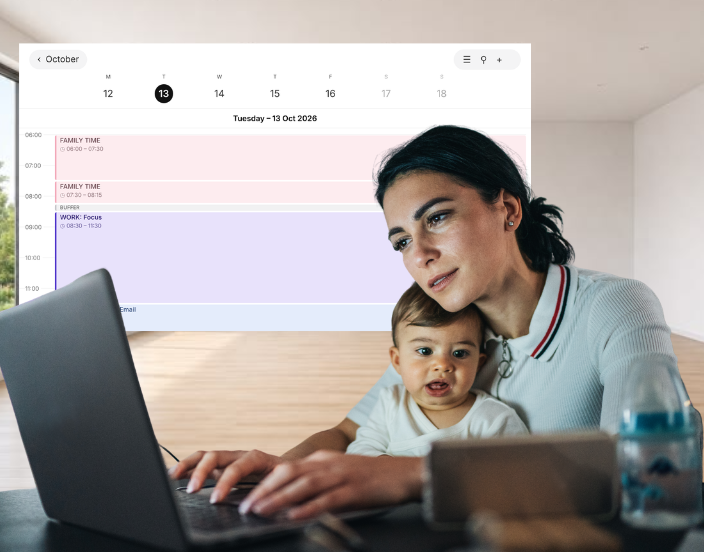
You start the morning with a plan. By ten o'clock, the nap has come early, or a child is home sick. A meeting has run over, and the one thing you wanted for yourself has moved to tomorrow, again.
If that sounds familiar, you're in good company. Most planning advice is written for people whose days follow a script. Life as a working mom rarely does, whether you have a baby or school-age kids. That gap can leave you feeling as though you're bad at planning, even though the tools were simply built for someone else's day.
Time blocking can still work beautifully for working moms. It can even lighten the mental load of carrying the whole day in your head. It just needs to bend around naps, school runs, work, and the unexpected, with a little room kept for you. This guide shows you how.
What is time blocking?
Time blocking is a way of planning where you give every task a set time in your calendar, instead of keeping it on a to-do list. Each block has one job, so you always know what you're meant to be doing and when. The author Cal Newport plans every minute of his workday this way. He credits it with getting far more done than working from a list.
The idea is simple. A task on a list competes with everything else for your attention. A task with a time has a place, which makes it easier to start and easier to let go of until then.
For most people, a time-blocked day looks like a column of neat, back-to-back slots. For working moms, it needs a different shape.
Why standard time blocking doesn't work for working moms
Classic time blocking assumes you control your hours. With a baby or young kids, a lot of your day is decided for you. That's where the usual method starts to wobble.
Plans move. A schedule built around a 1pm nap falls apart the day the nap comes at 11. The same goes for the day the school calls.
Interruptions are part of the job. Feeds, nappy changes, homework questions, and sudden fevers don't wait for the end of a block.
Your energy is unpredictable. After a broken night, the deep-focus block you planned for 8pm may be more than you can manage.
The plan lives in your head. Moms of young children carry about 73% of the household's mental load. Much of it lives in memory instead of the calendar.
Your own time goes first. When the day overflows, the block that gets cut is almost always yours.
The answer is a looser structure with a few fixed anchors, plenty of buffer, and one block that is protected for you.
The three blocks every mom needs
Instead of blocking every hour, start with three kinds of time. Everything else fits in around them.
1. Family time
These are the anchors of your day. With a baby, they're feeds and naps, and with older kids they're drop-off, pick-up and after-school activities. Dinner, bath, and bedtime apply to everyone. Block the ones that happen at roughly the same time each day, and give them a little extra room on either side. If naps vary, block the window they usually fall in, such as 12 to 2, rather than an exact time.
2. Work
Block your working hours, then split them into focus time and everything else. Put your hardest work in the hours when you're least likely to be interrupted. That might be while the kids are at daycare or school, or before everyone wakes up. Meetings, email and admin can fill the gaps.
3. Your time
This is the block most planners leave out, and it's the one that matters most for staying yourself. Choose one slot a day for the thing you want for you, such as a book, a course or a business idea. It can be twenty minutes or an hour. What counts is that it has a time and a place in the calendar. That way, it gets the same respect as everything else.
Once these three are in, the rest of your tasks go into the gaps. Errands, calls and chores slot in around the fixed blocks. Anything that doesn't fit today moves to a day where it does.
A real time-blocked day
Here's what a weekday might look like for a working mom with a toddler in daycare. With school-age kids, swap drop-off and pick-up for the school run and add homework time in the afternoon. Your times will differ, but the shape is what matters: fixed anchors, focused work, small buffers, and one block that's yours.
Time | Block | What happens |
|---|---|---|
6:00 to 7:30 | Family time | Wake-up, breakfast, getting dressed |
7:30 to 8:15 | Family time | Daycare or school drop-off |
8:15 to 8:30 | Buffer | Coffee, a breath, look at today's plan |
8:30 to 11:30 | Work: focus | The hardest task of the day |
11:30 to 12:30 | Work: meetings and email | Calls, replies, quick admin |
12:30 to 13:00 | Buffer | Lunch and one small errand |
13:00 to 16:00 | Work: everything else | Meetings, reviews, smaller tasks |
16:00 to 16:45 | Family time | Daycare or school pick-up |
16:45 to 19:00 | Family time | Play, dinner, bath, bedtime |
19:30 to 20:00 | Your time | Twenty minutes on your own goal |
20:30 to 20:40 | Brain dump | Plan tomorrow and switch off |
Two small details make this work. The buffers absorb the spills that would otherwise eat into your own time. The evening brain dump means tomorrow is planned before bed, so the morning starts with a clear head.
How to time block when the day goes off plan
Some days will go sideways, and that's part of the deal. A good time-blocked plan is one you can rearrange in two minutes, so you spend your energy on the day instead of the schedule.
Move blocks, keep the order. If the morning slips, slide your blocks later instead of deleting them. The work still happens, just at a different time.
Shrink before you cancel. A ninety-minute focus block can become forty minutes. Twenty minutes of your own time can become ten. A smaller block still keeps the thread going.
Protect your time last. When something has to go, cut errands and admin first. Your own block should be the last thing to move. If it does move, give it a new time straight away.
Use the buffers. Those small gaps in the plan are there for exactly this, so let them take the hit.
Reset in the evening. Use your brain dump to look at what moved, carry it forward, and plan a realistic tomorrow. One messy day says nothing about the system.
The aim is progress across the week. If your own goal got time on four days out of five, that's a week to be proud of.
A day with room for you
Time blocking as a working mom is less about perfect schedules and more about giving the important things a place. When family time, work, and your own time each have a home in the calendar, the rest of the day has something solid to fit around.
If you'd like a head start, the evening brain dump is the easiest place to begin. It clears the mental load and gives you everything you need to plan tomorrow.
Her Glow Hour does the time blocking for you. Each evening, you brain dump everything on your mind. The app then plans tomorrow around family time and work in your Google Calendar, with room kept for your own dreams.
Let Her Glow Hour time-block your day →
FAQ's
Does time blocking work with a newborn?
In the newborn weeks, keep it very light. Block only a few anchors, such as a daily walk or a call with a friend, and treat everything else as flexible. Fuller time blocking becomes easier once naps and feeds settle into a rough rhythm.
How do I time block as a working mom?
Start with your fixed hours: work, daycare or school, and bedtime. Then place your most demanding work in your most reliable quiet hours, add small buffers, and protect one short block for yourself.
What's the difference between time blocking and a to-do list?
A to-do list tells you what needs doing. Time blocking tells you when you'll do it. Giving tasks a time makes them more likely to happen and easier to stop thinking about.
What's the best way to time block my day?
Use the calendar you already check every day, such as Google Calendar, so your plan sits alongside work meetings and family plans. Planning the next day each evening keeps it realistic and means you wake up knowing what's next.