

How to reduce the mental load as a working mom
Six practical ways a working mom can reduce the mental load, from handing over whole jobs to giving every task a time, so there's room left for her.
It's 12 in the afternoon on a Tuesday, and you've finally stepped away from your screen with a sandwich, meaning to read a few pages of the book on your bedside table. Within a minute you're reordering nappies, then answering the daycare WhatsApp about Friday's dress-up day, then remembering that the twelve-month check-up still isn't booked. If you've ever searched for how to reduce mental load in a moment like this, you already know the problem has very little to do with how organised you are.
By the time you look up, the sandwich is gone and so is the break. Every item on that list was easy, and you'd have happily done any one of them, but together they filled the only half hour that was meant to be yours. That's the quiet trick of the mental load: each piece is small enough to feel silly to complain about, and the total is big enough to swallow your day.
This guide walks through six practical ways to make the load lighter, by sharing it, shrinking it, and giving your brain permission to stop holding it, so the time you set aside for yourself can actually stay yours.
Why the load stays put
The mental load is the thinking work of family life: noticing what needs doing, planning it, deciding and checking that it happened. My guide to what the mental load is and how to put it down covers the background and the signs you're carrying too much.
What surprises many women is how stubborn it is. A 2025 study of 2,133 partnered US parents by researchers at the University of Bath and the University of Melbourne found that mothers earning over $100,000 did less childcare and housework than lower-earning mothers, but carried just as much of the mental load. Mothers in the study handled an average of 13.7 mental tasks against 8.2 for fathers, and the biggest gaps were in scheduling, social plans and food. The researchers call this "gendered cognitive stickiness", and co-author Helen Kowalewska put it plainly: once organisational tasks are given to mothers, "they tend to stick."
That stickiness is useful to understand, because it explains why working harder or paying for more help rarely makes the load feel lighter. Physical chores can be outsourced, while the noticing usually stays exactly where it started. Reducing the mental load as a working mom means deliberately unsticking it, one area at a time.
Six ways to reduce the mental load
1. See it before you sort it
It's very hard to hand over something you can't name, so the first step is to get the whole load onto paper. Spend fifteen minutes listing everything you track across baby, health, home, money, people, work and yourself. The mental load checklist for moms gives you a guided version with columns for each stage, so you can see which items you carry from start to finish. Those fully ticked items are where the rest of this guide will make the biggest difference.
2. Hand over whole jobs, including the noticing
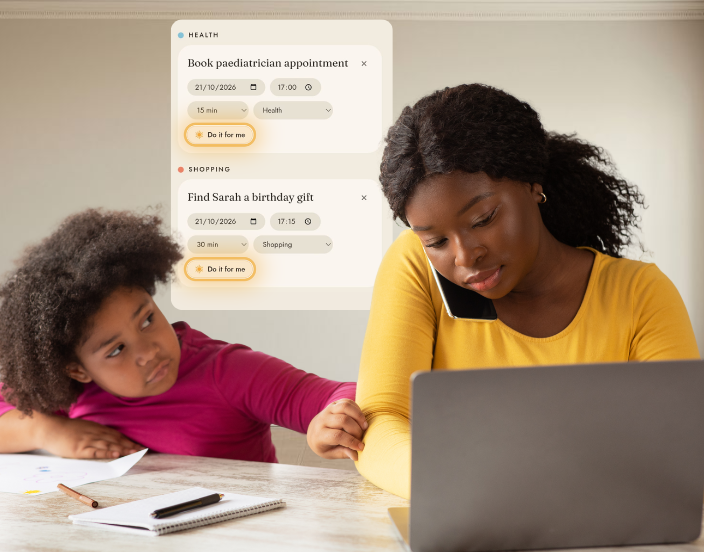
The most effective way to share household responsibilities is to pass on an entire area, such as birthday gifts, meal planning or everything to do with the car. When you hand over only the doing ("could you buy the gift?"), you're still the one who remembered the party, chose the present and checks that it arrived. Agree that the area now belongs to your partner, including the reminders and the follow-up, and then resist the urge to quietly track it in the background. The areas that stay with you can still lose some of their thinking, too. In Her Glow Hour, every task has a "Do it for me" option, so when the birthday gift is yours to sort, Ohra suggests a few ideas your friend will love and all that's left is choosing one.
3. Shrink the jobs that repeat
A surprising amount of the load is the same small decision made again every week. Set up a recurring grocery order for staples like nappies, wipes and milk, put bills on debit order, and keep a rotation of ten easy dinners so that "what's for supper?" has a default answer. A standing calendar reminder on the first of each month to check the medicine cabinet and daycare fees means you can stop carrying those in your head altogether.
4. Lower one standard on purpose
Some of what you carry comes from a standard you inherited without ever really choosing it. Pick one area where good enough really is good enough for this season, whether that's ironing, homemade birthday cakes or a perfectly tidy lounge before bed. Choosing to let it go is a decision, which feels very different from the low hum of guilt that comes from letting it slip.
5. Give every task a time
Unfinished tasks tend to keep tapping you on the shoulder, which is why you remember the check-up halfway through a meeting. Research by E. J. Masicampo and Roy Baumeister found that making a specific plan for an unfinished goal reduced the intrusive thoughts about it, even before the task itself was done. In practice, this means "book the twelve-month check-up" goes into your calendar at 9.15 on Wednesday, with the phone number in the event, instead of floating on a list. Once it has a time, your brain can stop rehearsing it.
6. Close the day with a brain dump
The habit that ties all of this together is a short evening reset. Once the house has settled, empty everything on your mind onto paper or into your phone, sort it, pick tomorrow's few things and give each one a slot around work and family time. I walk through the whole process in the ten-minute brain dump method. Doing it at the same time each night means the load gets set down once a day and stays down until morning.
Keep one thing on the list that's yours
Every time you reduce mental load at home, you free up a little space, and that space has a habit of filling straight back up with someone else's needs. So when you plan tomorrow, add one item that belongs only to you, such as chapter two, the course you've bookmarked or twenty minutes on the business idea, and give it a time too. The aim of all this lightening is to leave room for the woman who had plans of her own before the baby arrived, and still does.
A lighter head, and an hour of your own
The mental load won't disappear from family life, and it doesn't need to. What matters is that it's shared fairly, kept as small as it can be and set down each evening, so your days have space again for the things you want for yourself.
I built Her Glow Hour around that evening moment. You brain dump everything on your mind by talking or typing, the app sorts it for you, and then it time-blocks tomorrow around family time and work in your Google Calendar, with your Glow Hour protected in its own place.
Every task you add also comes with a "Do it for me" option, where Ohra, the AI assistant inside Her Glow Hour, helps you get it done. If dinner needs planning, Ohra suggests recipes based on the ingredients you already have at home. If the daycare needs a WhatsApp about Friday's dress-up day, Ohra drafts the message so all you have to do is press send, and if you're hunting for a birthday gift, Ohra helps you find something your partner or friend will love. Those are exactly the small, sticky jobs that ate your lunch break, and handing over the thinking behind them gives that half hour back to you.
Try the evening brain dump in Her Glow Hour →
Frequently asked questions
How can I reduce my mental load at home quickly?
Start with a full list of everything you track, then pick the one area that weighs on you most and hand it over completely, including the noticing and follow-up. Pair that with a short evening brain dump.
Why does the mental load fall on moms even when they work full time?
Research suggests that cognitive labour tends to stay with whoever first took it on, and that tends to be the mother, often from the early baby months. Earning more or working longer hours reduces mothers' physical chores far more than their planning and tracking.
Can an app help reduce the mental load?
It can, when the app takes on some of the thinking as well as the remembering. A brain dump that becomes a time-blocked calendar keeps tasks out of your head, and an assistant that drafts the daycare message or suggests tonight's dinner from what's in the fridge takes the planning off you too, which is the part of the load that tends to stick.
How long does it take for the mental load to feel lighter?
It varies from home to home, but handing over one whole area removes a full stream of reminders at once, so the change can be felt quite quickly. Give it about a month before judging, and adjust the split as you go.